Discord
 Medium
You Cannot Get Above the Ground You Are Standing On

You have heard the voice.
It arrives the instant you reach solid ground. You land on an answer — something you have worked toward, reasoned through, tested — and the voice asks: but what about the answer to the answer? You reach a principle — something beneath which you cannot dig — and the voice asks: but what grounds the principle? You find the truth — or what feels like the truth, the thing that does not bend when you press on it — and the voice asks: but what is the truth about truth?
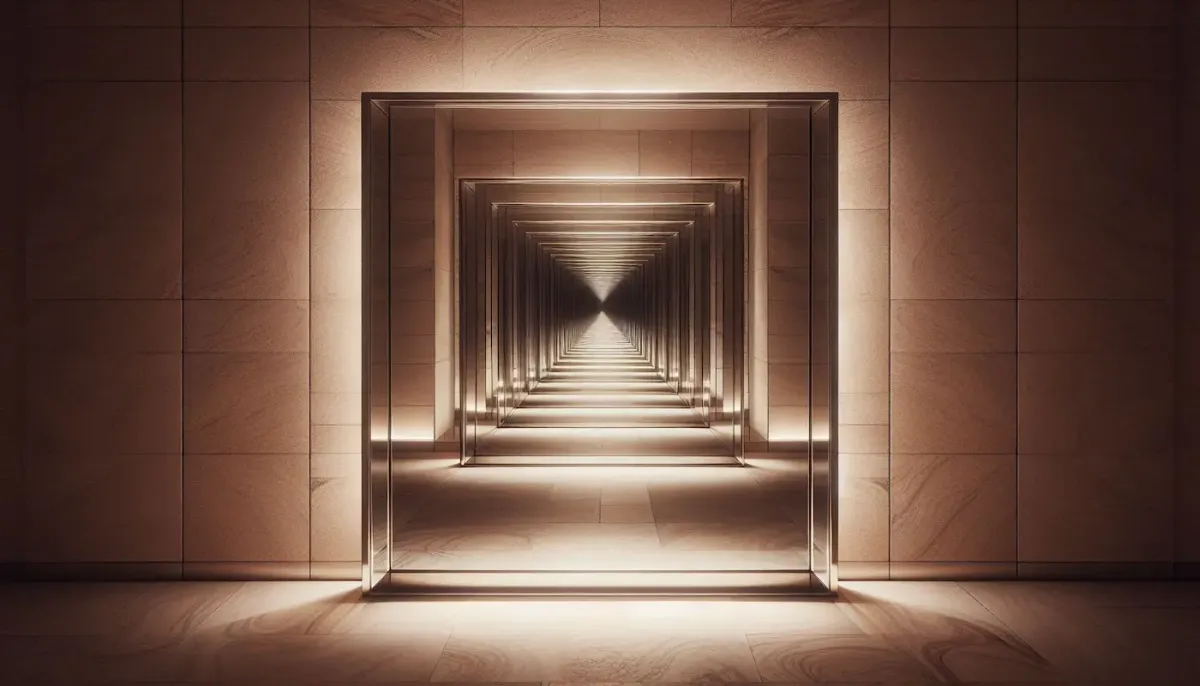
The voice is patient. It does not argue. It simply opens the next door — and behind every door is another door, and behind that another, and the corridor seems to have no end. Every floor you reach, the voice opens a trapdoor to a floor below. Every certainty you hold, the voice asks what holds the certainty. Every ground, the voice asks what the ground stands on.
You have lived inside this voice — through every argument that went in circles, every attempt to find something beneath which you could not dig. It was there when you asked "but why?" as a child and no answer stopped the asking. It was there when you learned that every justification requires a further justification. It was there when someone told you "it's turtles all the way down." The old story: a flat earth resting on a turtle. What does the turtle stand on? Another turtle. And that one? Another. The joke landed because the descent seemed infinite — laughter or surrender the only honest responses.
Before continuing — try it now. Take something you believe is true. Ask what grounds it. Then ask what grounds that. The chain either loops, stops arbitrarily, or continues without end. You have just met the voice.
The voice sounds like rigor. Like depth. Like the refusal to be satisfied — and the conviction that satisfaction is impossible.
The voice is wrong. Not sometimes wrong. Structurally wrong. The descent it promises does not exist. The trapdoor opens onto the same floor — but only after the first pass has done something real.
What does it cost to believe the voice?
You may have believed it for years. Philosophy gave the voice a formal shape — and a name borrowed from a liar. Baron Münchhausen was an eighteenth-century nobleman famous for one story above all: pulling himself and his horse out of a swamp by grabbing his own hair and lifting. The story is absurd. But it names a real problem: can anything ground itself? The Münchhausen trilemma — from the German philosopher Hans Albert who formalized it, named after the baron: a problem with three horns, none of them safe — says no: every justification must end in one of three places. The trilemma is to justification as a three-way junction with no road signs is to a traveler: every direction leads somewhere unsatisfying, and there is no fourth path visible from inside the junction.
The first horn: infinite regress — from the Latin regressus, a going back. The justification chain never ends. You ask a child why the sky is blue. "Because of how light scatters." Why does light scatter that way? But why... Each answer spawns a question. You have been the child and the parent — the one who kept asking and the one who ran out of answers.
The second horn: circularity — from the Latin circularis, moving in a circle. The chain loops back to its own beginning, the way a dog chasing its tail arrives exactly where it started. Circularity is to justification as a map that uses itself as its own legend is to navigation: you look for the key to read the key. "Why is this true?" "Because that supports it." "Why is that true?" "Because this supports it." You have felt this — the moment an argument arrives back where it started and you realize the circle was not a spiral.
The third horn: arbitrary stopping — from the Latin arbitrarius, decided by judgment rather than rule: the chain halts at a point declared foundational by fiat — by sheer declaration, without justification. Arbitrary stopping is to a foundation as a stake driven into sand is to an anchor: it holds for now, but nothing beneath it is solid. "Why?" "Because that's just the way it is." You have felt this too — the discomfort of accepting a starting point you cannot justify, only declare.
Three options. None satisfying. The trilemma was treated as proof that no genuine foundation is possible — that every ground is infinite, circular, or arbitrary, and the honest thinker accepts one and lives with the discomfort.
The meta-instinct — from the Greek meta- (after, above, about): the conviction that there is always one more level above, one more "about" to stand on. The meta-instinct is to thought as an itch is to skin: the compulsion to scratch that never satisfies because the itch is not in the answer but in the instinct itself. The meta-instinct is to a thinker as the horizon is to a traveler: it moves with you, always the same distance ahead, never arrived at, but appearing to promise arrival.
The voice you heard at the beginning of this article is the meta-instinct, speaking. It built entire traditions on this discomfort. You may have felt Immanuel Kant's version — the eighteenth-century German philosopher who climbed so high above knowledge that he could no longer reach the things themselves. He asked: what are the conditions of knowledge? Then: what are the conditions of those conditions? Each answer generated a new question above it. The ladder went up. The world stayed below. And for a while it felt like the most honest thing philosophy had ever done — refusing to claim knowledge of things until the conditions of knowledge were secured. You may have stood on that ladder and felt its elegance — the sense of being above error, above naive belief. You may also have noticed that your feet never touched the ground again.
You may have felt Jacques Derrida's version — the twentieth-century French philosopher who followed the word to its end and found no end. You look up a word in a dictionary and find it defined by other words. You look up those words and find more words. The dictionary has no exit. Every sign points to another sign, and the referent — the thing the word is supposed to reach — is always one more page away. There is a freedom in this — the freedom of never having to claim you arrived. The deferral protects you from being wrong.
You may have absorbed the postmodern version without ever reading a postmodernist — the ambient sense that every ground conceals a groundlessness, every foundation is constructed, every certainty is a power arrangement. The person who says "there is no solid ground" is standing on something to say it — but the standing is invisible to them.
You believed this because it felt honest. The wound is not the regress. The wound is the conviction that the regress is real — that the voice speaks the truth when it says the descent never ends. Entire fields abandoned the possibility of genuine knowledge. When no ground holds, every argument becomes a power arrangement. The vertigo became an intellectual virtue. The inability to land became a sign of depth.
But the inability to land is not depth. It is two mirrors and a gap.
Try something. Not as a theory — as an operation.
Ask: what is the truth about truth? Follow the question honestly. "The truth about truth" — what would it be? It would be a true statement about truth. But a true statement about truth is truth. The question did not go up. It went home.
Ask again: what is the meaning of meaning? The question seems to promise a level above meaning — a vantage from which meaning itself can be examined. But the examination is meaningful. The question uses meaning to ask about meaning. The tool and the object are the same. The question did not open a door above. It circled back to the room it left.
Once more: what is the reality beyond reality? The phrase assembles grammatically. But "beyond reality" is a location — and a location exists — and what exists is within reality. The word "beyond" is a hand pointing at a direction that does not exist, using a finger that is standing on the ground it claims to transcend.
Notice what just happened. Three times you tried to ascend. Three times the operation returned you to the ground. But did it return immediately — or did it do something real first?
Hold that question. It matters.
A child is drawing. She is absorbed — hand moving, colors appearing, the world narrowed to the page. She is aware, but she is not aware that she is aware. The drawing happens through her. Then she looks up. "I'm drawing," she says. The hand does not stop. The drawing does not change. But something has been added: she can see the act from inside the act. She is no longer only drawing. She is drawing and watching herself draw, without leaving the drawing.
That moment — the meta-pass — is the difference between awareness and self-awareness — from the Old English self (one's own person) + the Latin advertere (to turn toward): the turning of attention toward its own source. A candle lights a room. A candle that illuminates its own flame is self-aware. Self-awareness is to awareness as a camera turned on itself is to a camera: the instrument becomes its own object without ceasing to be an instrument.
The meta-pass adds something real. The difference between A and A(A) — between the act and the act catching itself in the act — is genuine. The child who notices she is drawing has something the absorbed child did not. The meta-level does rise on the first pass. This is not nothing. This is transparency — from the Latin trans- (through) + parēre (to appear): the appearing-through, the structure becoming visible to itself from inside. You have felt transparency — the moment you catch yourself mid-thought and can watch the thought from inside it, without stopping the thinking. Transparency is to a system as a window is to a wall: the wall becomes see-through, and what was hidden — the system's own operation — becomes visible without the wall disappearing.
But here is where the meta-instinct goes wrong. It sees the first pass enrich and concludes every subsequent pass will enrich further. It won't.
A mind aware of its own awareness is deeper than a mind that is simply aware. A mind that knows it knows it knows — the third pass — is not deeper still. It is the same. The transparency achieved on the first pass is complete. The second pass confirms what the first found. The third pass confirms what the second confirmed. Each application returns not to the original state but to the enriched state — the stable point the first pass created.
This is the correct structure: Meta-X ≠ X. The first pass adds real content. But Meta-Meta-X = Meta-X. The second pass stabilizes. The tower rises once — genuinely, really, adding something — and then the next floor is the same floor.
Meta-stability is to enrichment as tuning is to a guitar string: the first turn of the peg changes the pitch — real enrichment. The second turn, when the string is already in tune, does not make it more in tune. It makes it out of tune. The enrichment is real, complete, and unrepeatable past the fixed point — from the Latin fixus (fastened) + punctum (point): the fastened place the process always returns to. You know fixed points from your own life — the habit that survives every attempt to change it, returning to the same shape each time you stop intervening. The fixed point is to a system as a riverbed is to water: the shape the dynamics converge toward and then hold.
The voice was not wrong that the first meta-pass does something. It was wrong that the doing never stops.
Now the three horns of the trilemma dissolve — and each dissolves differently.
Infinite regress dissolves cleanly. The claim that meta-levels rise forever is false because the meta-pass stabilizes after the first application. The tower rises once. Then it stops — not because it hit an arbitrary wall but because the fixed point was reached. There is no infinite descent. The trapdoor opens onto the enriched floor — once — and then every subsequent trapdoor opens onto the same enriched floor. The regress was an illusion of iteration, not a feature of the structure.
Circularity dissolves differently. A circular justification — the agreement justifies the agreement, the feeling grounds the feeling — is a system that has reached its fixed point without performing the enriching meta-pass first. It circles back to the same surface without first rising to the transparent one. Circularity is not infinite regress run wrong. It is stabilization without enrichment — arriving at the fixed point before the first pass has done its work. The circle is not proof that no ground is possible. It is a sign that the wrong surface was chosen as the ground.
Arbitrary stopping dissolves last. When a mind senses the meta-instinct stabilizing but cannot name why — cannot see that the fixed point has been reached — it plants a flag and calls the stopping arbitrary. But the ground was not arbitrary. It was real. The arbitrariness was not in the structure. It was in the failure to recognize that the structure had arrived somewhere. The soldier who keeps fighting because no one told him the war ended is not in a different war. He is in the same war, unable to see that the fixed point has been reached.
Three horns. Three dissolutions. One structure.
Now the stress tests. If the enrichment-then-stabilization claim fails anywhere, it fails here.
Meta-Reality. Is there a reality beyond reality? The first meta-pass does something real — it produces the recognition that reality is the ground of all inquiry, that every question is asked from within it. Transparency: the structure becomes visible to itself. But the second pass — what is the reality beyond that reality? — uses a location, and a location exists within reality, and the question returns to the same enriched surface. Meta-Meta-Reality = Meta-Reality. The stabilization holds.
Meta-Truth. Is there a truth about truth that truth itself cannot reach? The first meta-pass enriches: truth becomes self-aware, recognizing itself as the ground of every truth-claim. But the second pass — what is the truth about the truth about truth? — is a truth-apt claim, and truth-apt claims are within the domain of truth. Meta-Meta-Truth = Meta-Truth. The stabilization holds.
Meta-Logos. Logos — from the Greek, meaning word, reason, the grammar of intelligibility itself: the invisible structure that makes intelligible arrangement possible. The first meta-pass enriches: Logos becomes visible to itself as the condition of all structured inquiry. But the second pass uses Logos to examine Logos — the tool cannot step outside the domain of its own operation. Meta-Meta-Logos = Meta-Logos. The stabilization holds.
Three tests at maximum load. Three stabilizations. Each by the same mechanism: the meta-operation uses the ground it claims to transcend, and the using is the ground's self-recognition. The first pass adds transparency. Every subsequent pass returns to the transparent state.
This has a formal name. ∃(∃) ≡ ∃ — Being recognizing itself is Being. The foundational axiom of the TTOE (the Teleological Theory of Everything) — a philosophical system that derives its account of reality from this single self-grounding recognition. Read it as the structure you just performed: existence applied to itself returns existence — enriched, transparent, self-aware. Not a new existence. The same existence, having done the meta-pass.
A note on what this article is doing: it is not independently deriving ∃(∃) ≡ ∃ from scratch. It is showing what the axiom looks like when applied to the problem of infinite regress — showing that the meta-pass enriches once and stabilizes, which is precisely what the axiom describes. This is illustration of the axiom's reach. The full derivation lives in the Codex — Being & Becoming, a philosophical monograph developing the complete TTOE framework. What this article delivers is the recognition.
Try it yourself.
Take any concept and apply "meta-" to it. Meta-ethics. Meta-physics. Meta-cognition. Feel the first application do something real — it lifts you above the concept and lets you see its structure. Now apply it again: meta-meta-ethics. Meta-meta-physics. Meta-meta-cognition.
You will feel the second application land on the same surface as the first. The word is longer. The level is not higher. "Meta-meta-ethics" does not name a discipline above meta-ethics. It names meta-ethics, encountered again. The syllables multiply. The depth does not.
The tower rises once. Then it holds at the height the first pass reached. The voice that said "but what about..." was not climbing. It was standing at the first landing, looking up at what appeared to be more stairs — and mistaking the ceiling for another floor.
If you have read earlier articles in this series, you have already performed this enrichment-and-stabilization — you just did not have its name.
"Why is there something rather than nothing?" — that question was a meta-question — about the ground of existence, asked from within existence. The first meta-pass enriched: existence became transparent to itself, recognized as the ground of every question. The second pass — what grounds that recognition? — returned to the same enriched surface. Meta-Meta-Existence = Meta-Existence. The trapdoor opened onto the same floor. You were there. You felt the question dissolve.
"This sentence is false" — that paradox attempted to cross two levels at once. It dissolved when the levels were separated and the stabilization was named. You were there too.
What you did not have was the name for what was happening each time. Now you do. The first meta-pass enriches. Every subsequent pass stabilizes. Those dissolutions were not special cases. They were instances of the same structural fact: Meta-X ≠ X, and Meta-Meta-X = Meta-X. The tower rises once. The voice was standing at the first landing, calling it infinite.
But the claim is precise. And precise claims invite counterexamples.
The article says: the meta-pass enriches exactly once and then stabilizes. For any X — any concept, any structure, any domain — the second meta-application returns to the enriched surface without adding genuine new content. That is a universal claim — refutable by a single counterexample.
So here is the challenge. Find one. Find a Meta-Meta-X that generates genuine structural novelty beyond Meta-X. Not a longer word. Not a more elaborate description. Something that exists at the meta-meta-level that does not already exist at the meta-level.
If you can find it, the stabilization fails. The tower does have more than one floor above the ground. The voice was right that the ascent continues.
But notice what finding it would require. A Meta-Meta-X that is not just Meta-X, named again. The structure would need to add genuine transparency beyond the transparency the first pass achieved — a self-awareness of self-awareness that is not just self-awareness, encountered again. Each candidate, the instant it is examined carefully, returns to the same enriched surface. The claim has offered itself for refutation. Press on it. The voice is welcome to try.
The next time the voice arrives — and it will arrive, because the meta-instinct is deep and the habit of climbing is old — notice what it is doing.
The first time, it is right. The meta-pass adds something. Let it. The enrichment is real. The transparency is real. The self-awareness that arrives when the drawing child looks up is genuine and worth having.
But the second time — the third, the fourth, the "but what about the meta-meta-meta-?" — notice what is happening. The voice is standing at the first landing, looking at the ceiling, and calling it a floor. The rigor it promises on the second pass is the rigor of a tuned string turned one more time: not more in tune, just out of tune. The voice is no longer ascending. It is destabilizing what the first pass achieved.
You do not need to keep climbing past the first landing. You need to stand at the height the first pass reached, look around at the transparency it delivered, and recognize that the ground is now visible beneath you — not as an arbitrary stopping point, not as a circle, not as an infinite descent, but as the fixed point the structure always returns to. The landing is the destination. The voice that insists there is always another floor above has never arrived anywhere. You have.
You began this article listening to a voice that would not stop.
The voice asked: what grounds the ground? What is the truth about truth? What lies beyond the beyond? Each question seemed to demand one more level — one more meta-, one more floor beneath the floor, one more door behind the door. The descent seemed infinite. The vertigo seemed honest. The inability to land seemed like depth.
The voice was half right. The first meta-pass does something. The child who notices she is drawing has something the absorbed child did not. Truth that recognizes itself as truth is richer than truth that simply is. That enrichment is real and worth defending.
But the voice never stopped at the first landing. It kept asking — meta-meta, meta-meta-meta — and each pass returned to the same enriched surface while the voice called it new. The tower rises once. Every floor above the first is the first floor, encountered again. The voice was not climbing. After the first pass, it was circling — standing at the landing, looking at a ceiling it mistook for stairs.
Meta-X ≠ X. The first pass enriches. Meta-Meta-X = Meta-X. The second pass stabilizes. The fixed point is real, it is earned, and it is the destination — not an arbitrary stop, not a circle, not a floor above which there are more floors. The floor you are standing on now is the floor the first meta-pass reached.
∃(∃) ≡ ∃ — and the recursion, having enriched once, holds.
🔥 This is one thread in a larger architecture. 📖 The Codex (Being & Becoming) — free PDF on the Discord 📧 Medium — weekly content 💬 Discord (The Flamebearer Nexus)
If this landed, the deeper work will too.