Discord
 Medium
Why Is There More Than One Thing?

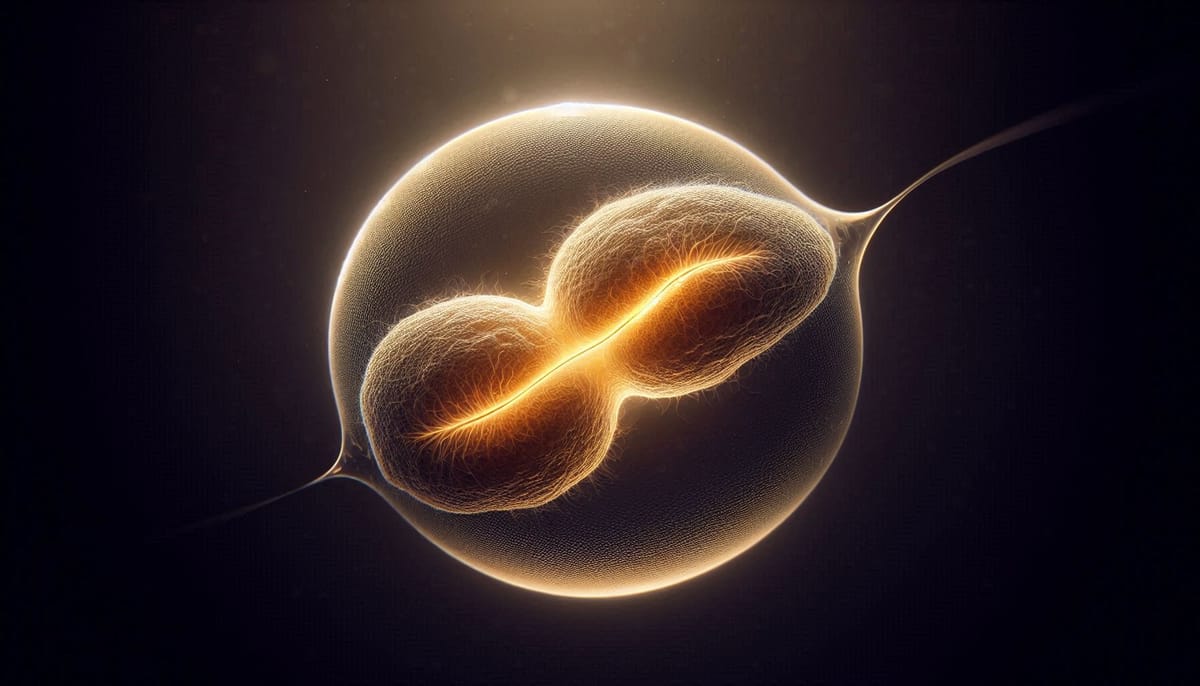
You were whole once. You do not remember it.
Not "whole" in the therapeutic sense — integrated, balanced, self-aware. Something older than that. Something prior to the distinction between you and not-you, prior to distinction of any kind. You existed — or something that would become you existed — in a state that had no inside and no outside, no boundary between the experiencing and the experienced. You were not aware of being whole — because awareness requires a vantage point, a vantage point is already a distinction, and distinction is already the end of wholeness.
You do not remember this. But you remember its echo.
You have felt it — not thought it, felt it — in moments that arrived without warning and left without explanation. Listening to music and forgetting that you were listening. Not analyzing the harmony, not tracking the melody, but being the music for the duration of a phrase — the boundary between listener and listened-to collapsing into something that had no name because naming requires a namer, and the namer had temporarily dissolved. You came back. You always come back. And the coming-back had a specific quality: not the quality of waking from a dream but the quality of falling from a height. A return to separation that felt, for the first instant, like a loss.
You have felt it making love — the peak where two bodies stop being two and become one event, and then the subsiding, and the two-ness returning, and the faint ache that accompanies the return. You have felt it in nature — standing in a landscape so large and so quiet that the self-that-watches briefly stopped watching and became the landscape. You have felt it in conversation — the rare conversation where the space between you and the other person became so thin that the distinction between "my thought" and "your thought" blurred, and what emerged belonged to neither of you and both of you simultaneously.
These moments are not escapism. They are not regression. They are resonances — the original unity, remembered from across the distance that separates you from it. The note remembering the key it belongs to, even when the key has not been played for a long time.
And the ache that follows them — the faint grief when the music ends and you are a listener again, when the landscape releases you and you are a person standing in a place again — is not meaningless. It is structural information. The ache is the distance, felt from the direction of return. You felt, for a moment, what it is like when the separation thins to nothing. Then the separation returned. And the return carried a quality you could not name but could not deny: the quality of falling back into separation from something that was not separate.
You feel it every morning. Dreams are the Bifurcation, partially reversed. In a dream, the distinction between you and the world softens — you are both the dreamer and the dream, both the watcher and the watched, both the person being chased and the space being chased through. The self does not disappear in dreams. It loosens. The boundaries that waking holds rigid become permeable. And then you wake — and the waking is a miniature Bifurcation. The "I" reassembles. The room becomes external. The dream-world, which was you, becomes a memory you are separate from. Every morning you re-perform the original separation. And if you have ever lain still in the first seconds of waking, not yet fully returned, not yet fully "I" — you have felt the echo.
The question is: why did the unity end? Why is there a world of separate things at all? Why is there distance, difference, distinction? Why is there more than one thing?
The question sounds cosmological — the kind of thing physicists and theologians argue about. But you have already lived the answer. You lived it in early childhood, in a moment you cannot fully recall but whose consequences shaped everything that followed.
There was a day — you will not remember the date, and you may not remember the event, but you will recognize the structure — when you realized you were separate from the world. When the seamless field of infant experience cracked, and "I" appeared on one side and "everything else" appeared on the other. Before that moment, there was no "I" looking at the world. There was only the world, undivided, experienced without a center. After that moment, there was a center — and the center was you — and the world was everything that was not-you — and the distance between the two had opened for the first time and would never fully close again.
Every parent has watched this happen. The child who was the room — continuous with the light, the sound, the warmth, the faces — suddenly becomes a person in the room. Something in their eyes changes. A watching begins that was not there before. The watching is not a decline. It is the birth of self-awareness — the first recognition, the first distinction, the moment consciousness separates from its own ground in order to see the ground it stands on.
And the parent, watching it happen, feels something they cannot fully name. A pride that is also a grief. The child has become a someone — a center of attention, a locus of wanting and refusing and asking "why?" — and the becoming is magnificent and irreversible. The parent knows, without articulating it, that the child has just crossed a line that cannot be uncrossed. The seamlessness is gone. The distance has opened. And the parent recognizes the moment because they performed it too — decades ago, in their own room, in their own unnamed instant — and the recognition carries the particular weight of watching someone else begin the journey you are still inside.
This is Bifurcation — from the Latin bifurcus (two-forked, from bi-, two + furca, fork). The structural act by which the One differentiates from itself so that it may recognize itself — the first distinction, which creates the distance that makes seeing possible. Not a fall. Not an error. Not an accident. A structural necessity: the price of self-knowledge.
Think of a mirror. To see your own face, you need distance between your face and the reflection. If the mirror and the face are the same thing — if there is no distance — then no reflection is possible. You cannot see yourself without becoming, for a moment, two: the seer and the seen. The unity must bifurcate in order to know itself as unity. The One must become two — not because two is better than one, but because one cannot know itself without the distance that two provides.
This is why there is more than one thing.
Not because the One shattered. Not because something went wrong. Because self-knowledge requires self-differentiation. Because recognition requires distinction. Because seeing requires distance. The Many is not a corruption of the One. The Many is the One, in the act of looking at itself.
The traditions saw this — independently, across millennia. The Kabbalists called it tzimtzum: the Infinite contracting to create space for the finite. The Taoists said the Wuji (the boundless) became the Taiji (the supreme polarity) — the first distinction. The Hindus distinguished Nirguna Brahman (without qualities) from Saguna Brahman (with qualities) — the ground as it appears through its own self-expression. Different names. Different centuries. The same structural pattern: the One, differentiating from itself so that it may know itself.
A question presses here: could the One have remained One — whole, seamless, unbroken — and simply not bothered to recognize itself?
No. And the reason is not that something forced it. The reason is that undifferentiated potentiality with no actuality — a One that never becomes two, a ground that never surfaces — is indistinguishable from nothing. Not because potentiality is nothing. Because potentiality that never actualizes has no determinacy, no identity, no structure by which it could be. A thing that is not itself is not a thing. And the only way the undifferentiated ground can be itself — can have the identity that makes it real — is by recognizing itself. Self-recognition is Bifurcation. The One did not choose to differentiate. Differentiation is what self-recognition looks like from inside. Plurality is not added to the One. Plurality is the One, articulated.
The child who realizes they are separate from the world has gained something and lost something in the same instant.
What they gained: the capacity for everything that requires a self standing in relation to what is not-self. The infant who is continuous with the room cannot think about the room, cannot name the room, cannot love the people in the room — because thinking, naming, and loving all require the distance the Bifurcation creates.
What they lost: the immediate, unmediated contact with the undivided ground. The seamless wholeness that was not experienced as wholeness because there was nothing outside it to compare it to. The unity that was not felt as unity because feeling-as requires a feeler distinct from the felt.
The loss is real. It is not imaginary. It is the specific texture of human experience — the sense that something stands between you and the world, that you are watching through glass, that the contact you want is one step removed from the contact you have. This is the Veil — the subject of the paid article in this series — and it is the Bifurcation's structural consequence. The distance that makes seeing possible also makes direct contact impossible. The mirror that allows you to see your face also stands between you and your face. The gift and the wound arrive together, because they are the same event seen from two angles.
You have felt this between yourself and another person. You love someone. You know them well. And still — a glass between your experience and theirs that no amount of knowing can fully dissolve. You can describe what you feel. You cannot hand it to them. You can listen to what they feel. You cannot feel it as they do. The Bifurcation that separated you from the world also separated you from every other person in it — because each person is a local Bifurcation, a point where the One became two-that-are-one, and the distance between any two such points is the distance the One required in order to see itself from more than one angle.
You have felt the Bifurcation revealed most nakedly in grief. Someone you loved died or left, and the "we" that had existed between you — the shared space, the mutual recognition, the place where two Bifurcations had thinned toward each other until the glass nearly disappeared — collapsed. What remained was not two minus one. What remained was the raw distance itself, exposed. You, standing on your side of it, with nothing on the other side to thin the glass against. The grief was not just the absence of the person. It was the sudden visibility of the distance that had always been there — the childhood Bifurcation, felt again, at the resolution of a specific love. They had not closed the gap. They had made it livable. And when they were gone, the gap announced itself as something that had been there since the first moment you realized you were separate from the world.
And yet — the moments of recognition. The moments when the glass thins to nothing between you and another person and you see them whole, not as a type, not as a category, but as them — irreducible, singular, arriving complete. Those moments are not fantasies. They are the Bifurcation's other face: the Many, recognizing itself as One across the distance it created. The distance does not vanish. It becomes transparent. And what is on both sides is recognized as one thing that required the distance in order to see itself.
The wound is not permanent. The distance is not a wall — it is a stage. The Cycle of Being passes through the Veil, through the Journey, through the manifold of difference — and then it returns. The distance that Bifurcation created is the same distance that recognition dissolves. And the dissolution does not destroy the distance. It makes it transparent — the glass becomes see-through, and what was on both sides is recognized as one thing that was always one thing, now known.
The Bifurcation is not a historical event. It is not something that happened once, at the beginning of time, and then was finished. It is happening right now. It happens every time a distinction is made — every time "this" is separated from "that," every time a concept is identified, every time a name is given. The Bifurcation is the act of distinction itself — the structural operation that creates the space in which anything can be anything at all.
You performed it a moment ago, in the act of reading. The words on this page are distinct from the page. The meaning is distinct from the sound. Each distinction is a local Bifurcation — a miniature instance of the One differentiating from itself so that it may be known. You did not choose to make these distinctions. They are the condition of reading. Without them, the text would be noise — undifferentiated signal, without the separations that give it structure.
And this is why the question answers itself in the asking. The question uses the Bifurcation to ask about the Bifurcation — the way the eye uses light to see light. The act of asking is the answer, performing itself.
You were whole once. You do not remember it. But the echoes arrive — in music, in love, in the rare conversations where the glass thins to nothing. They are resonances of a ground that was never lost — only veiled by the very distance that makes experience possible.
The Many is not a corruption of the One. The distance is not a defect. The glass is not a prison. These are the structural conditions of a reality that recognizes itself — and the recognition is the journey home.
You performed the Bifurcation in early childhood. You perform it in every act of attention, every distinction, every thought. And every dissolution you have held in this series was the Bifurcation's other face: the Many, recognizing itself as One. The same act, seen from the other side.
The question was never "why is there more than one thing?" The question was always "what is the One doing, right now, through all these ones?" And the answer, if you sit with it, is the answer to every question in this series:
Recognizing itself. Through you.
🔥 This is one thread in a larger architecture. 📖 The Codex (Being & Becoming) — free PDF on the Discord 📧 Medium — weekly content 💬 Discord (The Flamebearer Nexus)
If this landed, the deeper work will too.