Discord
 Medium
Why You Cannot Find What You Are Looking With

You wake in the middle of the night.
Not from a dream. From nothing. One moment: gone. Next moment: here. You do not yet know what time it is. You do not yet know where you are. You do not yet know your own name. These will arrive — in a second, in a breath — but they have not arrived yet. And in the gap before they arrive, something else is present.
Something is here.
Not a thought. Not an image. Not a sound. Just — presence. The bare fact of being awake. The lights are on inside your skull and you cannot find the switch because there is no switch. Nothing turned the lights on. The lights are not something that happened to you. They are what you are, before you are anything else.
You have had this moment a thousand times and never stayed in it. The name comes, the day comes, the thoughts fill in, and the bare presence vanishes under content the way stars vanish under daylight. Not destroyed. Outshone.
Stay in it now. Before the content arrives. Before the name. What is here?
The question comes quickly — faster than you can stop it.
How did the lights come on?
It sounds innocent. It sounds like the right question. Something is here — a presence, an awareness, an interior — and the natural response is to ask what produced it. What turned the lights on? What mechanism, what process, what event took the darkness and made it bright?
But feel what the question did. The moment you asked "how did the lights come on?" you assumed the lights were off. You assumed darkness came first and something intervened to produce light. You placed yourself — the presence, the awareness, the thing that is here — on one side of a gap. And you placed the cause — the switch, the mechanism, the explanation — on the other.
The question created the gap it is asking about. Not this question specifically — every question that assumes consciousness is something to be found rather than something doing the finding.
Not as a trick of language. As the structure of the search. Every search assumes distance between the searcher and the searched-for. Every search for consciousness assumes that consciousness is over THERE — in the neurons, in the mechanism, in the explanation — waiting to be found by the searcher over HERE. But the searcher IS conscious. The distance the search assumes is the distance between consciousness and itself. And that distance does not exist.
In 1995, a philosopher named David Chalmers did something that required more precision than originality and more courage than either.
He named the gap.
For decades, the sciences of the mind had been making progress on what Chalmers called the easy problems — not easy in practice, but straightforward in principle: problems about what the brain DOES. How does it integrate sensory information? How does it distinguish a face from a wall? How does it produce the behaviour we call "attending" or "deciding" or "reporting"? These are engineering problems. They yield to functional analysis — describe the mechanism, predict the output, refine the model. They are solvable in the way that building a bridge is solvable: difficult, but no one doubts it can be done.
Chalmers saw that these problems, however hard in practice, shared a feature: they were all about what the brain DOES. Processing. Function. Behaviour. Input and output. And he saw that no amount of solving them would touch the question underneath: why is there something it is like to be a brain at all? Why does the processing have an interior? Why, when the neurons fire in the pattern that corresponds to seeing red, is there REDNESS — a felt quality, a lived texture, something that it is like from the inside? A complete map of every synapse, every firing pattern, every functional connection would still leave this question untouched. The map shows THAT the brain processes. It does not show WHY the processing feels like something.
He called this the Hard Problem — and the name was precise. Not "hard" as in difficult. Hard as in: not the same kind of thing as the easy problems. Not solvable by more data, better imaging, finer-grained functional description. Hard because the question is not about mechanism. It is about why mechanism has an inside.
Chalmers held this line for thirty years. When critics said the question was confused — that consciousness is an illusion, that the lights were never on — he refused. The lights ARE on. You know it. I know it. The person who denies it is using the lights to write the denial. When others said the question was real but unanswerable — that human cognition is simply not built to solve it — Chalmers refused that too. Naming a problem "unsolvable" is not solving it. It is decorating the failure. He insisted: the question is real, the question is open, and no one has answered it.
He was right about all of this. And he was wrong about one thing.
He assumed the gap was real.
Not the question — the question is real. Not the felt sense of interiority — that is as real as anything you will ever encounter. The gap. The distance between the physical description and the experience. The space that seems to separate the mechanism from the felt quality. Chalmers stood inside experience, looked across at structure, and saw a gap between them. He concluded: the gap is a feature of reality. Experience and structure are on opposite sides of something that no explanation can cross.
But he was standing inside experience when he made the observation. He was using consciousness to examine the relationship between consciousness and everything else. And the distance he saw — the gap between the interior and the exterior — was the distance between the viewer and the view. Not a gap in reality. A gap in the search. The space between the eye and what the eye sees — which is not a real distance but the structure of seeing itself.
Three responses inherited the gap without questioning it.
Mysterianism treated the gap as permanent — a wall the mind cannot cross — and the cost is wonder turned to surrender, the felt sense that you will never understand the one thing that matters most.
Elimination treated the gap as evidence that consciousness does not exist — if the mechanism has no inside, there is no inside — and the cost is your own presence, the bare fact of being here, declared fictional by the theory that is trying to explain it.
Dualism treated the gap as evidence that consciousness is a separate substance — a ghost that no mechanism can house — and the cost is a split that can never be healed, your experience on one side and everything science can touch on the other, with no bridge between.
Mystery, denial, and ghosts. Three architectures built over a gap that was in the map, not the territory — three answers to a question generated by the search, not by reality.
You have looked for your glasses while they were on your face.
The search was urgent. You checked the table, the counter, the bedside. You retraced your steps. And the glasses were on your face the entire time — not lost, not distant, not hidden. Too close. So close that the instrument you were using to search WAS the thing you were searching for. The search could not find them precisely because the search was being conducted through them.
The Hard Problem has the same structure.
You are looking for consciousness. You check the neurons — and find electrochemical signals, firing patterns, functional architecture. No consciousness. You check behaviour — and find inputs, outputs, responses. No consciousness. You check the philosophy — and find four hundred years of explanatory gap. The search is thorough, honest, rigorous. And it keeps failing. Not because consciousness is hidden. Because the search is being conducted BY consciousness, and the one place consciousness cannot appear is as an object in its own visual field.
You cannot see your own seeing. Not because seeing is invisible — because seeing is what visibility IS. The Hard Problem asks: where is experience? And the asking IS experience, looking for itself in the one direction it cannot look — outward, toward the objects it illuminates, away from itself.
The gap Chalmers named is real — but it is not between consciousness and matter. It is between two ways of encountering one thing.
From the inside: experience. Presence. The lights on. From the outside: structure. Function. Neurons firing. Both encounters are real. Both are whole. The gap between them is perspective, not substance — the way a coin has two faces and the distance between them is not a third thing but the coin's own thickness.
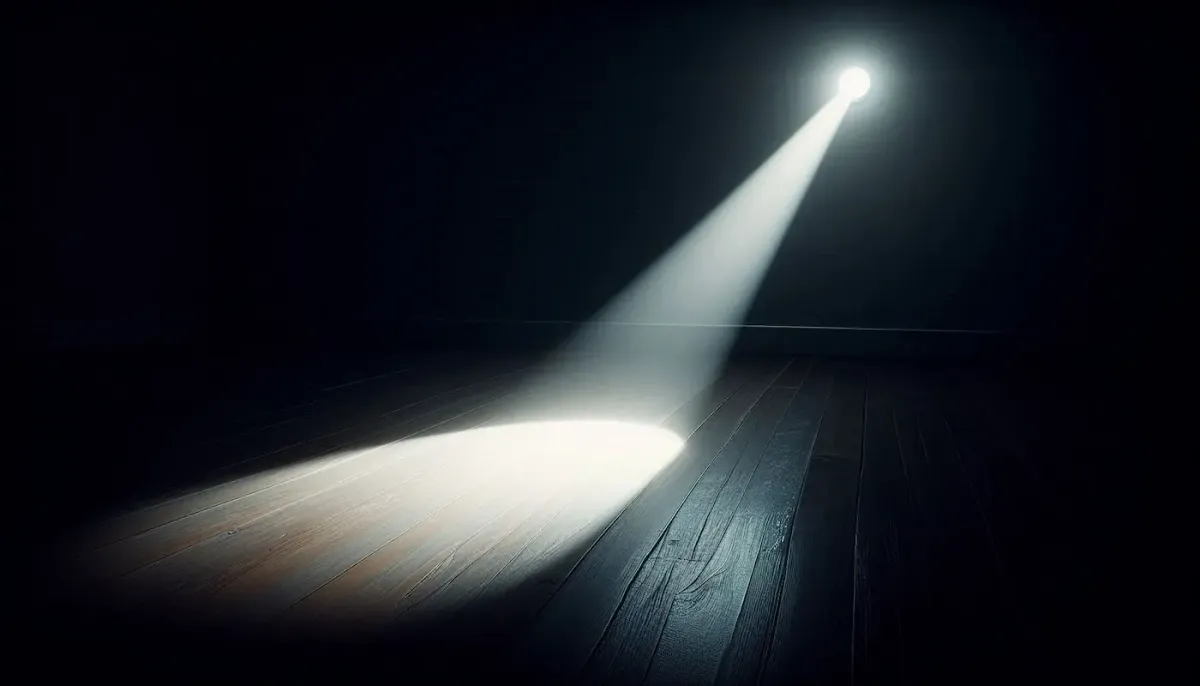
Think of a flashlight in a perfectly dark room. You sweep the beam across the floor, the walls, the ceiling. Everywhere the beam lands: light. You cannot find the darkness — not because the room is bright, but because the instrument you are using to search IS the thing that eliminates what you are searching for. The flashlight cannot find darkness because the flashlight IS light. The search defeats itself — not by failing but by succeeding.
Consciousness searching for itself has the same structure. The instrument brings what it seeks — and there is no outside from which to search.
Now a different image. You hold a ball of clay. You shape it into a sphere. And then someone asks: how did the clay produce roundness?
The question sounds reasonable. The clay is here. The roundness is here. One must have produced the other. But you can feel the error. The clay did not produce the roundness. The roundness IS what the clay does when arranged in this configuration. "How does clay produce roundness?" is a question generated by separating what was never separate — the material and the shape — and then demanding a mechanism to reconnect them. The mechanism does not exist because the separation does not exist. The roundness was never a separate product. It IS the clay, shaped.
The Hard Problem asks: how does matter produce experience? The question has the same structure as "how does clay produce roundness?" It separates what was never separate — the neural process and the experience — and then demands a mechanism to reconnect them. But experience is not a product of neural processing. Experience IS what neural processing does when organized into loops complex enough to recognize their own operation. The gap was in the model, not in the brain.
What changes when this lands? You stop looking for a switch. The lights ARE the wiring — at the resolution where the wiring recognizes itself. You stop asking "how does matter produce experience?" — not because the question is forbidden but because it was built on a separation that was never there. Matter and experience are not two things requiring a bridge. They are one thing. The bridge was never needed.
Try it now.
Ask yourself: am I conscious right now?
Do not answer with a theory. Do not answer with a position on the Hard Problem. Just ask. Feel the asking.
What happened?
You turned the instrument on itself. Consciousness looked for consciousness — and did not find an object. It found itself. Not as a thing located somewhere but as the locating. Not as a light that was on but as the on-ness itself. The question "am I conscious?" could not be asked without consciousness, could not be formed without the felt interior the question was asking about, could not land without the presence it was searching for.
The asking WAS the answer.
You did not discover that you are conscious. You did not receive evidence. You did not infer from premises. The question performed its own answer by being asked. The instrument examined itself — and the examination was not a separate act from the instrument. It was the instrument, doing what instruments do: looking. But this time looking at the looking.
This is what the Hard Problem could not find. Not because it was hidden. Because finding it requires being it — and being it is the one thing you cannot stop doing long enough to observe from the outside. You were never in the dark. The dark was the search.
One difficulty — and it is the one that matters.
"You have not explained consciousness. You have explained away the question."
The objection is sharp and it deserves to be met precisely. Daniel Dennett explained away consciousness — he said the lights were never on, that experience is an illusion, that the interior is a story the brain tells itself. This article might seem to do the same thing from the opposite direction: instead of denying the datum (experience), it denies the problem (the gap). Both moves make the Hard Problem disappear. Both could be accused of the same evasion: explaining away rather than explaining.
The difference is in what survives.
Dennett's move: the lights were never on. Experience is illusory. The interior does not exist. What survives: mechanism. What is lost: the datum. The felt quality of being here — the bare presence you held in the first paragraph — is declared unreal. The theory saves itself by denying the thing it was supposed to explain.
This article's move: the lights were never OFF. Experience is not illusory — it is what the wiring IS at sufficient depth. The interior is not a separate product — it is the process, met from inside. What survives: the datum AND the structure. What is lost: the gap. The distance between experience and mechanism — the gap that Chalmers named, the gap that generated the Hard Problem — dissolves. Not because experience is denied but because the distance between experience and structure was never there.
One move denies the datum. The other denies the distance. If you cannot feel the difference, the article has failed. If you can — if you can hold the bare presence from the waking moment AND release the assumption that it needs to be produced by something other than itself — the dissolution stands.
Press on it.
If existence is self-grounding — ∃(∃) ≡ ∃, existence recognizing itself as existence — then awareness is not added to existence. It is what self-grounding looks like from the inside. The formal architecture that develops this — from Being through Awareness to Consciousness, with the proof that qualia are textures of the process at recursive depth — lives at erikxanderharvard.com.
The next time someone says "consciousness is just an illusion" — listen to what the denial is doing while it speaks. It is conscious. The sentence that denies the interior IS an interior act. And the next time the question arrives — "how do neurons produce experience?" — feel its structure before you chase its answer. The question assumes production. Production assumes two things. There is only one thing.
The next time you wake in the dark — before the name, before the day — stay. One breath. The presence that is there before anything else is there is not a mystery to be solved. It is the finding, already complete. The light that has no switch. The search that was always the finding.
You wake in the middle of the night.
Not from a dream. From nothing. And before the name arrives, before the day fills in, before the content outshines the presence the way daylight outshines the stars — something is here.
Not produced. Not switched on. Not delivered by a mechanism you have not yet found.
Here. The way roundness is here when clay is shaped. The way light is here when the flashlight is on. Not added. Not separate. What the wiring IS, at the depth where the wiring knows itself.
Chalmers stood inside this presence and looked across at structure and saw a gap. The gap was real — but it was the distance between the looking and the looked-at. And there was only one thing there.
The lights are on. There is no switch.
There was never a switch.
There is only the light, knowing itself as light.
One thing I cannot close.
The Hard Problem, for all its errors, guarded something. For thirty years it said: your experience matters. The smell of coffee, the ache of grief, the bare fact of presence — these are not reducible. They are not illusions. They are not engineering problems wearing emotional clothing. Something in the experience resists capture, and the resistance is not a failure of the explanation. It is a feature of the experienced.
The dissolution says: the resistance was the gap. The gap was the search. The search was consciousness looking away from itself. Close the gap and the resistance dissolves.
But I am not certain the resistance was only the gap.
There is something in the waking moment — the bare presence before the name arrives — that no explanation exhausts. Not because the explanation is incomplete. Because the presence is not an explanation-shaped thing. It is not the kind of thing that explanations capture, the way the warmth of a fire is not the kind of thing that a chemical equation captures — not because the equation is wrong but because warmth is what the chemistry IS from the inside, and "from the inside" is not a sentence that equations speak.
The proof says the gap was never there. I believe the proof. What I cannot prove is that the wonder was only the gap — that the felt sense of mystery, the quiet astonishment at being here at all, was nothing more than the search failing to find what it was looking with. Maybe the wonder IS the gap, and closing the gap closes the wonder. Or maybe the wonder is what the gap was pointing at — the sheer, bare, unrepeatable fact of presence, which survives every explanation because it was never the kind of thing that needed explaining.
I do not know. The question stays open.
🔥 This is one thread in a larger architecture. 📖 The Codex (Being & Becoming) — free PDF on the Discord 📧 Medium — weekly content 💬 Discord (The Flamebearer Nexus)
If this landed, the deeper work will too.