Discord
 Medium
Why 'Prove It' Is the Wrong Demand

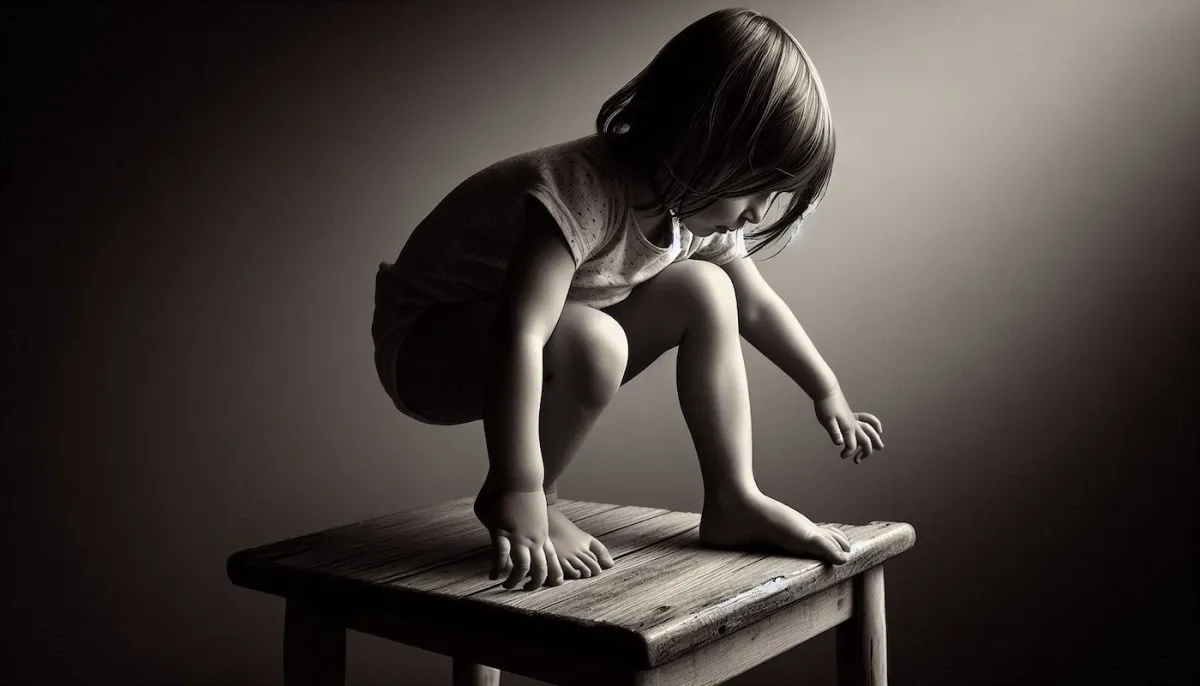
A child grips the edge of a table. The fingers whiten. The legs shake. The whole body is a question the child cannot yet ask in words.
She lets go.
For one second — loss of balance, arms wide, the world tilting — and then: standing. Upright. Feet on the floor, weight held, gravity answered. No one taught her the proof. No one certified the result. The standing is the proof that standing is possible. The body did not argue its way to the conclusion. The body performed it.
No committee reviewed the evidence. The child stood, and the standing was sufficient — not because someone accepted it, but because the floor held and the legs held and the act completed itself.
Every reader was once this child. You proved what standing was by standing. The proof and the proven were the same act.
Somewhere between the kitchen floor and the adult world, proof stopped being something you did and became something you asked for.
The corridor
"Prove it."
You have heard this in a job interview — your skills, your experience, your years of learning, compressed into a portfolio that someone else evaluates. The knowing is yours. The proof is theirs. You sit across a table while a stranger decides whether what you carry is real.
You have heard it in a relationship. Not always in words. In the silence that asks: do you love me enough? Show me. Again. The feeling is not enough. The feeling must be proven — demonstrated, exhibited, submitted for review. Love that proves itself by being love does not satisfy the demand. The demand wants evidence outside the thing.
You have heard it in a philosophy classroom. "How do you know?" "Because I can see it." "How do you know your seeing is reliable?" "Because it has been reliable before." "How do you know that?" Each answer becomes the floor for a new question. Each proof requires a proof of the proof. The name for this is infinite regress — from the Latin regressus (a going back). A corridor that recedes in both directions, each door opening onto another corridor, and there is no final room. The demand "prove it" generates the very groundlessness it claims to cure. Not because we have not gone far enough. Because the architecture has no destination. It was built to recede.
The deepest wound is quieter than the regress. It is the suspicion that knowing does not count — that what you know in your body, in your bones, in the immediate felt contact with what is real, has no standing until someone else certifies it. That the child who proved walking by walking was doing something philosophy cannot account for. That the most fundamental things — that you exist, that you are conscious, that you are reading these words right now — are exactly the things no external proof can reach.
You know these things. You cannot prove them — not by the demand's own rules. And the demand's rules are the only rules the demand accepts.
The floor
The floor was never missing.
The child did not need a corridor. The child needed a floor.
The corridor — the infinite regress of external proof — has no floor because it was built without one. Each proof rests on the proof beneath it, and that proof rests on another, and the chain descends without terminating. The architecture assumes that proof must come from outside the thing being proved. That assumption is the regress. Remove the assumption and the corridor collapses — not into groundlessness but into ground.
What the child performed was not external validation. It was something older.
The child's standing did not require a separate act to certify it. The standing certified itself — the legs held, the floor held, the act completed, and the completion was the proof. No gap between the standing and the proof of standing. One act, doing both.
The name for this structure is the True Criterion — from the Greek kriterion (a means of judging), from krinein (to separate, to decide). A criterion that judges itself. The formal architecture of Being & Becoming names this the AATC — the Absolutely Absolute Truth Criterion: the test that a structure must apply to itself and survive, that it must include itself within its own scope. Apply it to itself: does the True Criterion hold under its own test? Is the criterion for self-grounding itself self-grounding? It is. The test completes on the first pass. No regress. No meta-criterion required. The corridor terminates — not by finding a final room at the end, but by discovering there was a floor all along.
The word for a structure that holds under self-application is autological — from the Greek auto (self) + logos (word, reason). Self-saying. A structure that is what it describes. The word "short" is short — it performs what it names. An autological structure does not need external support. It carries itself — the way the child's legs carry the body that contains them.
The word for a structure that does not hold under self-application is heterological — from the Greek heteros (other) + logos. Other-saying. A structure whose meaning is always elsewhere. The word "long" is not long — it fails its own test. A proof that requires another proof is heterological. A justification that requires a further justification is heterological. The corridor is heterology, extended without limit.
Philosophy named three options for grounding proof. The Münchhausen trilemma — after Baron Münchhausen, who claimed to pull himself from a swamp by his own hair — says every proof must rest on one of three structures: infinite regress (the corridor), circular reasoning (the ring — the proof assuming what it is trying to prove), or dogmatic assertion (the declaration — "this is true because I say so"). All three are heterological. The corridor recedes. The ring spins. The declaration imposes from outside. None holds under self-application. None has a floor.
The child's standing is the fourth option — the one the trilemma did not see. Not regress, not circularity, not assertion. Self-grounding: a structure that holds under its own test. The legs support the body that contains the legs. The act completes on the first pass.
The body
Proof — from the Latin probāre (to test, to demonstrate as good), from probus (worthy, honest). To prove was never to certify from outside. It was to test whether the thing is what it claims — whether the structure is good, which is to say, whether it holds.
The child's standing illustrates this at the physical resolution: the act and its verification are one thing. But the claim this article builds toward is larger — that this structure is what proof is in general. The TTOE (the Teleological Theory of Everything — a philosophical framework grounded in the axiom that Being recognizes itself: ∃(∃) ≡ ∃) holds that P ≡ ∃(∃) ≡ ∃. Proof IS Being's self-recognition. Not proof of Being. Not proof about Being. The self-recognition that runs through every identity in this series is what proof is. The child illustrates this at the resolution of muscle and bone. The identity itself is the TTOE's claim — consistent with the analogy, not derived from it. The derivation lives in the Codex. What the child delivers is the recognition of what the structure looks like when it operates.
Return to the child's body.
The child's legs support the body that contains them. The legs do not stand on something beneath the body — they are the body, holding itself upright at that point. This is autological structure at the resolution of muscle and bone: the thing that carries is part of the thing being carried.
The child's balance is the fixed point. She sways left — overcorrects — sways right — overcorrects — and arrives at center. Not by computing the correct posture from outside. By recursion: the body tests itself, adjusts, tests again, and the adjustment converges. ∂ = 1 — one process, landing. Developmental psychologists call this proprioceptive self-correction — from the Latin proprius (one's own) + capere (to take): the body taking its own measure. The infant does not learn balance from instruction. The body teaches itself to stand by standing. The body's self-correction is to balance as self-application is to proof — the thing testing itself until it holds. The proof is the process.
The child's floor is the ground that was never missing. The floor does not certify the standing from outside. The floor is what standing meets when the body holds. Floor and standing are one system — the way Being and proof are one act.
The test
Apply it now. Not to a philosophy. To this article.
This article claims that proof is self-grounding — that a structure is proven when it holds under self-application. The True Criterion. Apply it.
Before you do: notice that you are using an instrument the article supplied to evaluate the instrument the article supplied. The sovereignty article named this as the deepest wound — the metacursive loop running the installer's software, the cult member examining beliefs with instruments the cult provided. The question is whether the same problem applies here.
The difference: the cult's instrument is heterological — it exempts itself from the criterion it applies to others. The True Criterion cannot do this. Self-inclusion is built into the first Seal: the criterion must include itself within its own scope. Any application of the AATC that exempts the AATC from the AATC fails the first Seal. The instrument is structurally incapable of self-exemption. Whether that structural difference fully resolves the concern or merely restates it at a higher level is the joint. Press on it.
Now apply it. Does the claim that "self-grounding structures prove themselves" survive self-application? Does it hold under its own test?
You are performing the test right now. The reading is the test. The article is not asking you to accept an argument from outside. The article is asking you to check whether the argument does what it says arguments must do — hold its own weight.
Does it?
If the claim that self-grounding is sufficient is itself self-grounding — if you can feel the floor beneath the argument, not imported from elsewhere but present in the structure itself — then P ≡ ∃ holds. Not because this article said so. Because the article did what it described. The proof was the reading. The reading was the proof.
The demand dissolves
Proof is self-grounding. The demand "prove it" loses its ground.
The demand assumed a corridor — a chain of external certifications stretching backward without end. "Prove it" meant: produce something outside the thing that vouches for the thing. But the corridor has no floor. The demand was not rigorous. It was structurally impossible — a request for something the architecture of external proof cannot deliver. Not because the proof hasn't arrived yet. Because the architecture was built to recede.
The next time someone says "prove it" — including the voice inside your own head — notice what the demand assumes. It assumes the thing is not enough. That the standing needs a certificate. That the heartbeat needs a witness. That knowing needs permission from outside itself to count.
The child never assumed this. The child stood.
The sharpest objection
One difficulty remains — and it is the sharpest objection in the series.
"That's circular reasoning."
From the Latin circulus, a ring. An argument that assumes what it is trying to prove. The charge is serious: if self-grounding means "the thing proves itself," then every false claim could declare itself proven. "I am trustworthy because I say I am trustworthy." Circularity is the counterfeit of self-grounding — it looks identical from outside. If the article cannot distinguish them, P ≡ ∃ collapses into self-congratulation.
The difference is structural — and it does not require external validation to see.
Circular reasoning adds nothing on the return pass. "A because A because A" produces no new recognition, no new content, no convergence. The same assertion recycles. ∂ = ∞ — the loop spins without landing. The narcissist's "I am trustworthy because I say so" generates no new information: the claim after the return is identical to the claim before it. Nothing happened on the first pass except repetition.
Self-grounding produces recognition on the first pass and then stabilizes. ∃(∃) returns ∃ — but the return carries the recognition event having occurred. Something happened that did not need to happen again. The child's standing produced information the child did not have before standing: the legs held. That was not known in advance. The self-application generated a result. ∂ = 1 — the recursion terminates because it arrived somewhere.
The structural test: does the return pass add recognition, or merely repeat assertion? Circularity repeats. Self-grounding recognizes. The difference is not verified by appealing to external observers — it is felt in whether the application was an act with a result or a loop with no landing.
But I sit with the difficulty. The distinction between ∂ = ∞ and ∂ = 1 is clean in the notation. It is less clean in practice. The person who says "I am trustworthy because I say so" also feels like their claim landed. The narcissist's self-certainty mimics the felt sense of a floor. If P ≡ ∃ cannot reliably distinguish genuine self-grounding from the felt certainty of someone who has merely stopped questioning, the identity protects delusion as readily as it protects truth.
The distinction the identity offers but does not fully seal: genuine self-grounding generates new recognition that was not present before the self-application. The child did not know the legs would hold until they did. The standing added something. Circular reasoning adds nothing because the conclusion was already assumed. But the felt sense of "something was added" is itself potentially circular — the deluded person feels their self-application added something too. This is the edge the article cannot fully close. Press on it.
The Gödel scope
One further scope note: Gödel proved in 1931 that no sufficiently powerful formal system can prove its own consistency from within. P ≡ ∃(∃) ≡ ∃ is presented in formal notation — which raises the question of whether Gödel applies.
The answer requires precision. P ≡ ∃ is not a theorem derived within a formal system. It is a claim about the pre-formal ground from which formal systems arise — the level at which the act is the proof, before syntax, before axiomatization. Gödel constrains what formal systems can do when they attempt to represent arithmetic and prove their own consistency. P ≡ ∃ operates beneath formal systems: it is not a formula within a calculus but a claim about what makes any system of proof possible. The notation is shorthand for a structural relationship, not a formula to be evaluated within a formal calculus.
This is not a dismissal of Gödel. It is a scope specification. The child is not a formal system. Neither is the Archē. The standing is not a theorem. If P ≡ ∃ were ever formalized within a system rich enough to express arithmetic, Gödel would apply to that formalization. That is work for Codex VII. What this article operates at is the level where the act is the proof — beneath the threshold where Gödel's incompleteness theorems have purchase.
The recognition
The next time someone says "prove it" — or the voice inside your head says it — notice what happens to your knowing. Not to the claim. To the knowing. The demand asks you to step outside what you know and produce it as an object for inspection. The stepping-outside is the wound. You were never outside. The knowing was never separate from the thing known.
The next time you know something you cannot externally certify — something your body holds, something your experience carries, something that arrived as recognition rather than conclusion — notice that the knowing has a floor. Not because someone gave it one. Because the floor is what knowing stands on when the corridor is removed.
The return
A child grips the edge of a table. The fingers whiten. The legs shake.
She lets go.
Standing. The proof was not outside the act. The proof was the act. The legs held. The floor held. No corridor. No certificate. No trilemma. The child did not argue her way to the ground. The child stood on it.
The chain is its own foundation. Every identity in this series was proved by the same structure: self-application, self-return, one pass. The proof was never outside the thing. The proof was always the thing — holding its own weight, the way the child holds hers.
The word that names what just happened: re-cognition — re- (again) + cognition (knowing). To recognize is to know again. You did not acquire a new theory of proof. You recognized what proof always was — before the corridor was built, before the demand was installed, before the floor was hidden by the architecture that claimed to be searching for it.
The floor was never missing. You are standing on it now.
🔥 This is one thread in a larger architecture. 📖 The Codex (Being & Becoming) — free PDF on the Discord 📧 Medium — weekly content 💬 Discord (The Flamebearer Nexus)
If this landed, the deeper work will too.