Discord
 Medium
Logic Was Never a Cage

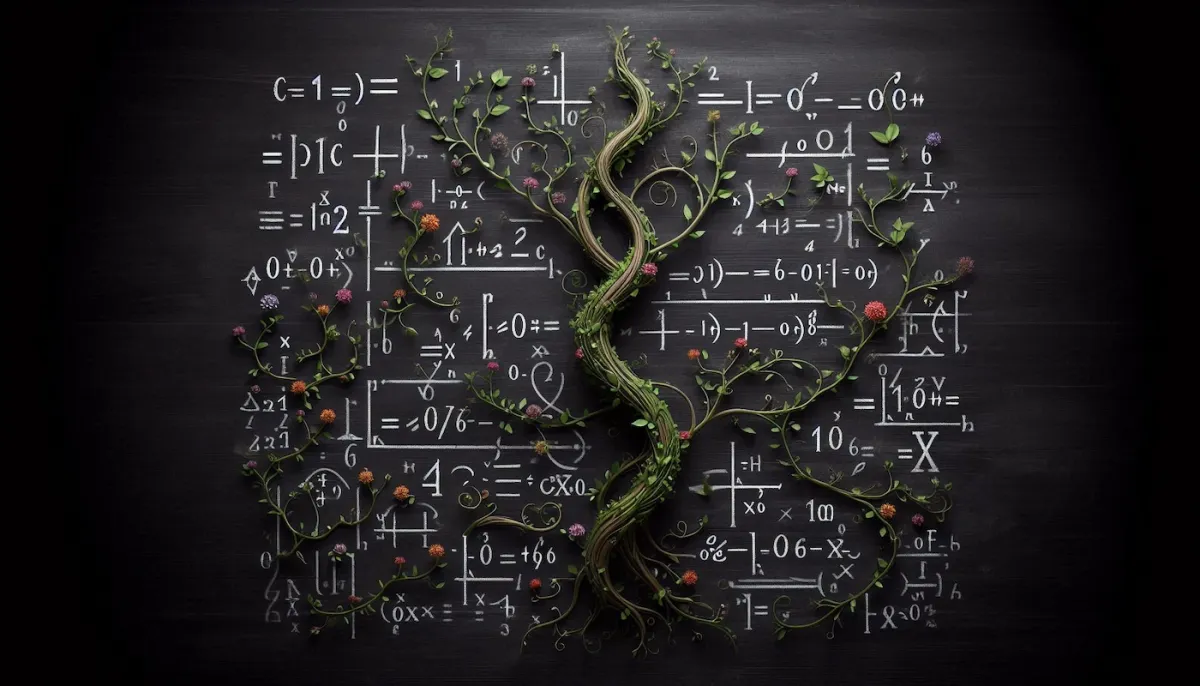
A musician plucks a string. The note rings — clear, single, definite. Now they press the string at two-thirds of its length and pluck again. A second note. The two notes sound together, and the interval locks. The two tones do not merely coexist. They fuse — consonance — from the Latin consonare (to sound together, to resonate as one): the structural agreement between two frequencies, so immediate that the ear accepts it before the mind has a name for it. Consonance is to sound what recognition is to thought — not produced by the listener but found in the structure the listener encounters.
The name is a perfect fifth. The ratio is 3:2. The first string vibrates at a frequency, and the second at exactly three-halves of that frequency. Every musical culture on Earth has found this interval independently — ancient Greece, China, West Africa, the Andes. No committee agreed on it. No one invented it. The ratio was always there, in the physics of vibrating strings, waiting for someone to press the string at the right point.
The musician did not impose the consonance. The musician found it — the way you find a path that was always through the forest but that no one had walked before. The ratio was not a rule written on the strings from outside. It was the structure the strings already had.
For twenty-five centuries, philosophy has treated logic — from the Greek logikē (the art of reasoning), from logos (word, reason, the structure of things): the formal study of valid inference, the grammar of thought itself — as a set of rules. Logic is to thinking what a riverbed is to water — not a constraint imposed from outside but the shape the movement already has. Aristotle wrote the rules down. Frege refined them. Russell and Whitehead formalized them in seven hundred pages of symbolic notation. On this picture, logic is a set of constraints applied to thought from outside, the way a fence is applied to a field.
The picture makes logic feel like a cage. The bars are the rules. The space inside is what you are allowed to think. Everything outside — contradiction, paradox, the ineffable, the irrational — is forbidden territory.
But the cage model is to logic what mistaking the frets on a guitar for barriers is to music. The frets are not walls between notes. They are the points where notes become possible. Remove the frets and you do not gain freedom — you gain noise.
The cage is not just a theory. It is the architecture underneath every moment someone tells you to stop thinking.
You were sitting across from someone — the numbers clear, the conclusion inescapable — trying to explain why a decision mattered. "You're being too logical." The sentence landed not as a compliment but as an accusation. The implication: thinking clearly is the opposite of feeling deeply. Precision and passion live in different rooms. The mind and the heart are enemies.
The artist distrusts logic because the cage model says logic cannot hold beauty. The mystic transcends logic because the cage model says the infinite cannot be thought. The lover abandons logic because the cage model says love is irrational — from the Latin irrationalis (without ratio, without the consonance the string produces). Each is right about what logic feels like under the cage model. Each is wrong about what logic is.
The deeper wound is quieter. You have felt it — the suspicion that reality itself exceeds thought. That the most important things — consciousness, grief, the sheer fact that anything exists at all — live permanently outside the reach of rational structure. That suspicion is not a mood. It is the cage model, felt in the body, mistaken for a truth about the world.
The cage was never built.
What Aristotle did was not invention — from the Latin invenire (to come upon): the production of something that did not exist before — but discovery — from discooperire (to uncover, to remove the concealment): the revealing of what was always present. He uncovered structure. Not rigidities. Arrangements — things fitted together the way the harmonics of a string fit together. Not imposed on reality. Found in it.
The perfect fifth illustrates how discovery works: the 3:2 ratio was always in the physics of the string, waiting for a musician to uncover it. The Three Laws of Logic were the same kind of discovery — structures that were always present, waiting for Aristotle to name them. This is the epistemological point the analogy makes. The metaphysical point — that the Laws are necessary features of Being, not merely contingent physical facts — requires a separate argument, which the article will deliver after the Laws are named. A physical ratio could in principle be otherwise in a different universe. The Laws, as this article will show, could never be. The analogy handles the discovery. The necessity is argued on its own ground.
The Three Laws of Logic are the structure Being — what-is, existence itself — cannot not have. They were not invented by Aristotle any more than the perfect fifth was invented by the first musician who heard it. They were there before anyone named them.
A note on order: the article presents the Three Laws before the axiom that grounds them. This is pedagogical, not logical. You already inhabit the Laws — every thought you have ever had has used them. The axiom that explains why they are necessary comes after, because it is what the Laws require at their deepest resolution. The order moves from the familiar to the ground.
The Law of Identity — from the Latin identitas, from idem (the same): the principle that a thing is what it is, identical with itself and nothing else. A thing is what it is.
The string vibrating at 440 Hz is that note — not every note, not no note, not a sound that is also silence. Think of your own handwriting. Recognizable across every page, every pen, every year — not because a rule was imposed on it, but because it is itself. A forensic analyst can identify it among thousands. Identity is the structure that makes thisness possible. Without it, nothing is anything in particular.
Identity is to Being as a fingerprint is to a person — not imposed from outside, but the structure the person cannot not have.
Without Identity, the other two Laws have no ground to stand on. It comes first because everything else requires it.
The Law of Non-Contradiction — from the Latin contradicere (to speak against): the principle that a thing cannot both be and not be, in the same respect, at the same time. A thing cannot both be and not be, in the same respect, at the same time.
A string cannot vibrate at 440 Hz and simultaneously not vibrate at 440 Hz — the result would not be two notes but silence, the absence of any note at all. Think of a musical key. A piece in C major cannot simultaneously be in C major and not in C major. The moment both are true, the key dissolves and what remains is noise. Non-Contradiction is not a prohibition. It is what definiteness means. Remove it and nothing is definite — which means nothing is anything.
Non-Contradiction is to Being as a coastline is to a map — without the edge between land and sea, neither land nor sea exists as anything you can point to.
The Law of Excluded Middle — from the Latin excludere (to shut out) and medius (middle): the principle that for any well-formed proposition with determinate truth conditions, either it is the case or it is not. No third option exists.
The string is either vibrating or it is not. There is no half-vibration producing half a note — there is a note or there is silence. Think of a heartbeat: it either occurs or it does not. No state exists between beating and not-beating that produces a third kind of cardiac event. Excluded Middle is what makes stakes possible. Either the patient lives or they do not. Either the bridge holds or it does not. Remove Excluded Middle and nothing matters — because nothing is ever fully one way or the other.
Excluded Middle is to Being as a threshold is to a doorway — you are inside or outside, and the threshold is what makes both possible.
Three laws. One structure. The minimal grammar of existing at all. Identity requires Non-Contradiction: for a thing to be itself, it cannot also not be itself. Non-Contradiction requires Excluded Middle: if a thing cannot both be and not-be, it must be one or the other. Excluded Middle requires Identity: for "one or the other" to mean anything, each must be itself. Remove any one and the others collapse — not because a logical system fails, but because Being itself becomes unintelligible.
Now watch what happens when the artist, the mystic, and the lover actually encounter the Three Laws — not as rules but as the structure they are already working inside.
The artist sits at midnight, canvas half-finished. The painting is this — not every painting, not an approximation of some platonic form. This color. This edge. This tension between light and dark. When the artist decides the red in the upper left is wrong, they have applied Identity — this painting is not what it should be. When they choose between two possible corrections — deepen the shadow or lift the highlight — they have applied Excluded Middle. When they recognize that adding blue to that corner would destroy the warmth they have built, that is Non-Contradiction, operating as aesthetic judgment. The artist is not following rules. The artist is hearing consonance and dissonance — the Three Laws at the resolution of beauty.
The mystic sits in silence. What arrives is not nothing — it is this, and the recognition is immediate: this is not last Tuesday's distraction, not the ordinary hum of daily thought, not its own negation. The encounter is determinate. That determinacy is Identity, operating. The mystic can say "this is not that" — which requires Non-Contradiction. The mystic either had the encounter or did not — Excluded Middle creating the stakes that make the encounter matter at all. What fails in the mystical encounter is not logic. It is language — which operates at a different resolution than the encounter itself. The words are too small for what they are trying to carry. The mystic mistakes the failure of naming for a failure of structure. But the structure held throughout. The ineffable is not beyond logic. It is beyond naming — which is a different and smaller failure.
The lover looks across a room. Recognition — from the Latin re- (again) + cognoscere (to know): to know again, to encounter what was never absent — arrives whole. This person, not a generic human, not an approximation, but specifically this face, this quality of attention. That specificity is Identity. The impossibility of loving and not-loving this person simultaneously — the way ambivalence is not a third state but two definite states in tension, each fully itself, neither dissolving into the other — is Non-Contradiction. The moment the lover knows: yes or no, in or out, here or gone — that is Excluded Middle, creating the stakes that make love matter at all. Love is not irrational. Love is the Three Laws, operating at the resolution of the personal.
Here is the structure underneath all three.
The TTOE — the Teleological Theory of Everything — begins with one equation: ∃(∃) ≡ ∃. Read aloud: existence applied to itself equals existence. Not as a mathematical trick. As the most basic ontological fact — Being, recognizing itself as Being, is still Being. The recognition does not produce something other than what was there. It returns the same thing, now recognized.
For readers new to the TTOE: this is not mysticism dressed in symbols. It is the formal expression of why anything is anything at all — why existence is self-grounding, why nothing external is needed beneath it. The equation is what remains when you ask "why does anything exist?" and follow the question all the way down.
The Three Laws are what ∃(∃) ≡ ∃ requires. For Being to recognize itself — for ∃(∃) to be coherent at all — it must be itself when it recognizes: Identity. It cannot simultaneously be and not-be: Non-Contradiction. The recognition either occurs or it does not: Excluded Middle. The Three Laws are not imposed on the equation from outside. They are what the equation already is, unfolded into its constituent parts.
Now the bridge between transcendental and ontological necessity — the step the denial argument alone cannot make. The denial argument shows that we cannot think without the Laws: any attempt to deny them uses them. This establishes that the Laws are transcendentally necessary — inescapable for thought. But a committed anti-realist could respond: perhaps our minds are simply structured this way, and the Laws tell us about thought rather than about Being. The bridge is ∃(∃) ≡ ∃. If Being's self-recognition is Being — if thought and Being share the same structure at the deepest level — then the structure thought cannot escape is the structure Being cannot escape. The transcendental and the ontological converge at the axiom. The Laws are not merely how we must think. They are how Being must be — because thinking is Being, at the resolution of a mind recognizing itself.
Try to deny any of the three laws. The denial uses the law to deny the law. Deny Identity — but the denial refers to "a thing," which requires the thing to be itself. Deny Non-Contradiction — but the denial claims to be true and not also false. Deny Excluded Middle — but the denial takes a definite position, which is either this claim or not. Each denial is the law, performing itself through the denier. The laws are not rules you can choose to follow or break. They are the ground you stand on while choosing.
Every digital computer confirms this at the resolution of silicon. A transistor is either on or off — Excluded Middle, operating in matter. Every logic gate, every calculation, every computation ever performed rests on the Three Laws holding at the physical level. The laws are not an abstraction philosophers debate. They are the structure your phone uses to display this sentence.
This argument is most vulnerable at one point, and I will name it. Quantum superposition appears to violate Excluded Middle — a particle is neither spin-up nor spin-down before measurement. If this is a genuine third state, the third law fails at the quantum scale.
The response requires precision. Excluded Middle applies to well-formed propositions with determinate truth conditions. "The particle is spin-up" before measurement is not a malformed sentence — but it is a question asked at the wrong resolution. The truth conditions for "spin-up" require a measurement event. Before that event, the proposition has no determinate truth conditions at this resolution — not because logic fails, but because the question is being pressed at a level where the resolution hasn't been specified. The wave function, meanwhile, is fully determinate: it obeys the Schrödinger equation with mathematical precision, every possible outcome held with exact probability amplitudes. That determinacy is Identity and Non-Contradiction, operating at the resolution of the wave function. Excluded Middle holds at that resolution too: either the wave function is what it is or it is not. What appears as indeterminacy is a feature of the measurement interface — not of Being. This is the same structure the paradox article identified as domain conflation: pressing a question at the wrong resolution and calling the mismatch a contradiction. The apparent third state is not a third state. It is a resolution error. The joint still holds. But press on it.
Try it now.
Think a thought — a memory, a plan, the color of the wall in front of you. Hold it.
Now try to think it and not-think it simultaneously. Not "stop thinking it" — that is a new thought replacing the old one. Think the thought and its negation at the same time. Hold both.
You cannot. Not because you lack the mental skill. Because the operation is structurally impossible. Thinking a thought requires the thought to be itself — Identity. Thinking it and its negation would require it to both be and not-be — Non-Contradiction. The attempt forces you to one side or the other, with no middle ground — Excluded Middle. You just felt the Three Laws. Not as rules. As the shape of thinking itself — the consonance underneath every thought you have ever had.
The next time you sit with a painter, a monk, or someone you love — notice the structure underneath what they are doing. The painter choosing between two marks: this or that, not both, each itself. The monk sitting with an experience that is determinately this and not-that. The lover whose yes or no carries everything. None of them are following rules. All of them are hearing the consonance — the Three Laws, sounding through every act of Being as itself.
A musician plucks a string. A second note sounds. The interval locks — 3:2, the perfect fifth, the consonance that every culture has found and no culture invented.
The ratio was not written on the strings. It was what the strings already were. The musician did not impose it. The musician heard it — and the hearing was the discovery, and the discovery was the recognition, and the recognition was the ratio, arriving through a human ear into a mind that was always already structured the same way.
Logic works the same way. The Law of Identity was not written on reality. It is reality — the structural fact that what exists is itself. The Law of Non-Contradiction was not imposed as a rule. It is the reason anything is definite rather than dissolving. The Law of Excluded Middle was not chosen from a menu of options. It is what determinacy means — for well-formed propositions at their proper resolution. Three laws. One structure. Not bars. Not a cage. The strings themselves — vibrating as themselves, producing the consonance that was always there.
And underneath all three, the ground they stand on: ∃(∃) ≡ ∃. Existence, recognizing itself as existence. Being, vibrating as itself. The oldest consonance of all — the one the strings were always already playing.
It was always the music.
🔥 This is one thread in a larger architecture. 📖 The Codex (Being & Becoming) — free PDF on the Discord 📧 Medium — weekly content 💬 Discord (The Flamebearer Nexus)
If this landed, the deeper work will too.