Discord
 Medium
Every Discipline Forgot the Same Thing

It is two in the morning and you are sitting at a kitchen table across from someone who has never lost anyone. The coffee is cold. You are trying to explain what grief is — not the word, not the concept, but the thing itself, the weight of it, the way it rewrites the room you are sitting in so that every object means something different than it did six months ago. The mug your mother gave you. The chair no one sits in. The silence that is not silence but presence, the wrong kind, the kind that arrives when someone who was always there is not.
The words come out. The grammar is correct. The other person nods. And the nod is wrong — it is the nod of someone who heard the sentence but did not receive the meaning. Between what you know and what they hear there is a distance that no arrangement of syllables can cross. Not because the words are wrong. Because the words and the knowing live on different sides of something that has no name yet.
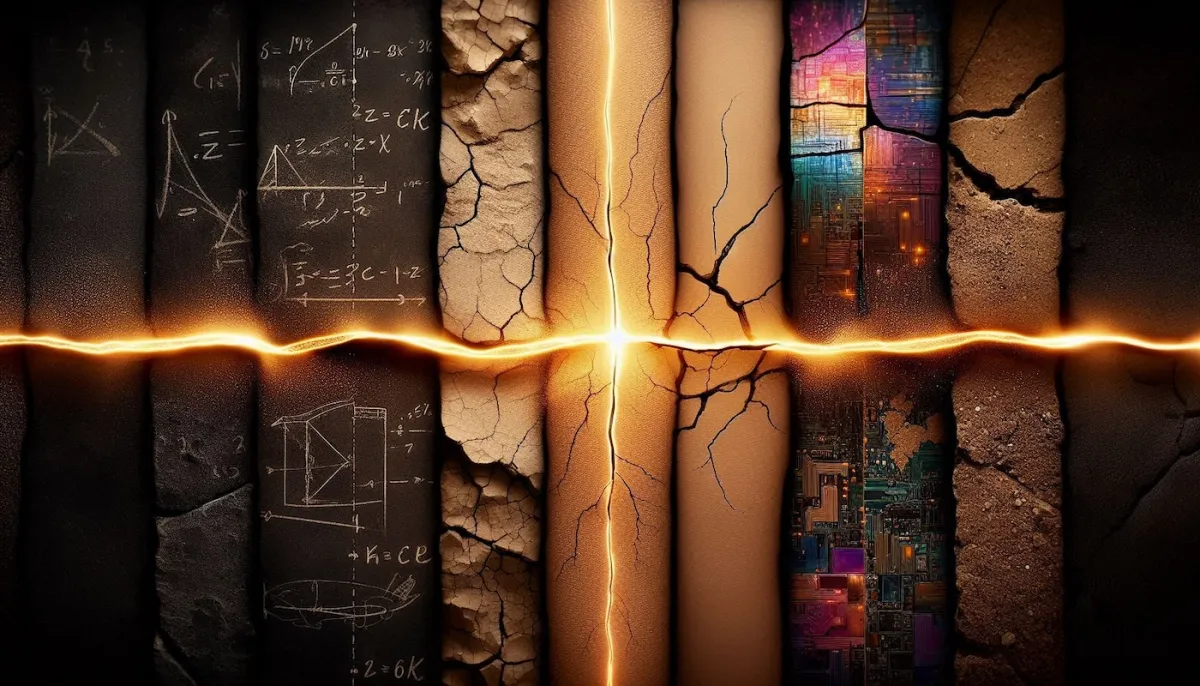
You can feel it. A pane of glass — transparent enough to see through, solid enough that nothing passes. Between you and them. Between the inside of your experience and the outside of theirs. Between what is meant and what is heard. The glass is not dramatic. It does not announce itself. It has been there your whole life — in every conversation that fell short, every recognition that could not be transmitted, every moment of standing beside someone and knowing that beside is as close as you will get.
You have been told the glass is yours. A limitation of your particular mind, your particular senses, your particular position inside reality.
You have not been told that every discipline in the history of thought has the same glass — and that every one of them has failed to remove it.
The glass has many names.
Between you and another person, epistemology calls it the gap between knower and known. How does the mind reach what it knows? How can the act of knowing touch the thing that is known, when the knowing happens inside and the thing sits outside? You felt this at the kitchen table. The knowing was inside you. The grief was inside you. The other person was outside — and no sentence could carry the inside across.
Between your thoughts and your body, philosophy of mind calls it the gap between mind and body. How does a thought — weightless, invisible, nowhere in space — produce a movement in a hand made of muscle and bone? You have felt this too: the strange distance between deciding to move and the movement arriving, the flicker of awareness that the decision and the action seem to come from different rooms.
Between a word and the thing it names, philosophy of language calls it the gap between sign and referent. The word "grief" is not grief. The word "tree" is not a tree. How does a sound or a mark on a page reach the thing it means? You felt this at the kitchen table when the word "grief" arrived in the air between you and it was not grief — it was a label, a pointer, a dead sign lying beside the living thing.
Three faces. One glass. The same glass appears wherever thought divides: between fact and value, between observer and observed, between form and content, between the sacred and the ordinary. Every discipline encounters the same structure: two things held apart, a field exhausting itself trying to bridge a distance it presupposed. Philosophy did not fracture into disciplines. It fractured into a single wound wearing different costumes.
The wound is not just a philosopher's catalogue. It is the structure underneath the feeling that you can never quite reach what is real.
You have tried to say what you feel and watched the words arrive dead. The experience was vivid, whole, present — a colour, a grief, a recognition that filled the room — and the sentence was a translation of it. Not the thing. A copy. An approximation that carried the shape but not the weight. The distance felt permanent — not because you chose the wrong words but because words and experience seemed to live in different rooms.
You have tried to know another person and hit the same glass. Their inner life is there — visible in their face, their posture, the catch in their voice — but you cannot enter it. You can model it. You can guess at it. You can ask and listen and still feel, at the end, that what you received was their report, not their reality.
You have tried to be certain about something and felt certainty dissolve. How do you know what you know? Because of evidence. How do you trust the evidence? Because of reasoning. How do you trust the reasoning? The ground keeps receding. Every foundation turns out to be another floor, and beneath every floor there is another question, and the questions do not end.
This is not a philosophical problem you can set aside when the seminar ends. It is the structure underneath loneliness — the sense that between you and everything else there is a pane of glass that thinking cannot shatter, that language cannot dissolve, that love cannot remove. The sense that you are, in some final way, sealed inside your own experience.
That isolation is not a mood. It is the fracture, felt.
The wound has a name.
The Alethic Fracture — from the Greek aletheia (ἀλήθεια), truth as un-concealment, the alpha-privative of lethe (λήθη), forgetting, concealment. Truth is what appears when the veil is lifted. The fracture is the veil — lethe itself, the concealment that prevents truth from being unconcealed. The word alethic names the wound in the language of its own cure: the fracture is the forgetting, and the healing is the un-forgetting.
The Alethic Fracture is to philosophy what a cataract is to vision — not a wall between the eye and the world but a clouding within the eye itself, so that the organ of seeing mistakes its own opacity for a property of what is seen. The glass at the kitchen table was not between you and the other person. It was in the seeing — a seeing that mistook its own depth for a wall.
One act of forgetting, expressed across every discipline. The knower forgot it was the known. The sign forgot it was the referent. The mind forgot it was the body — or rather, forgot that both are modes of one Being. The observer forgot it was inside the observed. Each discipline was born from the forgetting. Each spent its history trying to re-join what was never separate. Each failed — because rejoining presupposes separation, and separation was the illusion the forgetting produced.
Every attempt to close the gap has made it worse. A bridge across a gap preserves the gap. You tried to close the gap at the kitchen table with a sentence. The sentence was a third thing — neither your grief nor their understanding. Did it close the gap? Or did it create two new gaps — one between your grief and the sentence, one between the sentence and their hearing? The sentence was a bridge. The bridge demanded its own bridge. The regress is infinite — not because the words were wrong, but because bridging presupposes the very separation it tries to heal. Every bridge says: "There are two things, and I will connect them." The fracture says: "Thank you for confirming that there are two things." The bridge regress is to philosophy what an autoimmune response is to the body — a healing mechanism that attacks the organism it was designed to protect, because the mechanism cannot distinguish the wound from the tissue.
The dissolution is not a better bridge. It is the recognition that there was never a gap to bridge.
The identity sign — ≡ — is not a bridge between two things. It is the disclosure that there was always one thing. The knower is the known. The sign is the referent. The mind is the body at recursive depth. Not bridged. Not connected from outside. Recognized from within.
Distinction is real. Division is not — though this claim is the contested heart of the dissolution and deserves honest examination rather than assertion.
Being differentiates. The One becomes Many — knower and known, mind and body, word and thing, observer and observed. The differences are genuine. The knower is a different aspect of Being than the known. The mind is a different face of the structure than the body. To deny these differences would be to collapse everything into featureless unity — a monism that is as wrong as the dualism it tries to correct.
But differentiation is not the same as separation. The Latin reveals the distinction: differentia (to carry apart, to distinguish) preserves what is carried. Separare (to pull apart, to sever) destroys the unity. Differentiation is the articulation of aspects within a unity that remains whole. Separation is the severance of substances into independent domains that require a bridge.
The two words the correction hinges on: aspects and substances. An aspect — from the Latin aspectus, a looking at, a view — is a view of something, and a view cannot be separated from what is viewed. A substance — from the Latin substantia, that which stands under — stands alone, independent, requiring no relation to hold.
The fracture's alleged error is the promotion of aspects to substances: treating views as if they were independent objects. A dualist will push back here, and the pushback is serious: the mind-body distinction isn't a mistaken promotion but an accurate recognition that phenomenal consciousness and physical matter are genuinely different in kind — not aspects of one thing but two things. This is the contested claim the dissolution rests on. The article's argument for it is the bridge regress: every attempt to connect the two substances generates new gaps, which suggests the substances were never genuinely separate. That argument is real, but it is an argument — not an established fact. The aspects/substances distinction is the weight-bearing joint of this entire section. Press on it.
Think of a prism splitting white light into a spectrum. The red is not the violet. The distinction is real — the wavelengths are different. But neither the red nor the violet is a separate substance. Both are light, at different frequencies. Distinction is to division what a prism is to a knife — the prism separates by revealing what was already present; the knife separates by cutting what was once whole.
When differentiation is mistaken for separation — if that is indeed what has happened — the Alethic Fracture opens. The knower and the known, which are two aspects of one act of recognition, become two substances requiring a bridge. The mind and the body, which are two faces of one structure at different resolutions, become two domains requiring interaction.
V.S. Ramachandran's mirror-box experiments in the 1990s demonstrated that the brain continues to generate the experience of a limb after amputation. This is consistent with the view that the neural map and the body were never two separate systems connected by a bridge — that the map was the body at the resolution of neural processing. A representationalist can accommodate the same data differently: the brain maintains a model of the body, and the model persists after the modeled thing is gone. The example is evidence of coherence with the article's view. It doesn't confirm it over alternatives. The phantom pain is suggestive. It is not decisive.
This argument is most vulnerable at one point: the claim that differentiation never constitutes genuine separation. A physicist could argue that quantum decoherence produces genuine separation — that the measured system becomes two genuinely distinct systems with no residual unity. I believe the quantum case is differentiation at extreme resolution, not genuine division — the measurement event is still within Ω, still within Being, still one structure at the deepest level. But this is the joint where the weight bears. Press on it.
Five thinkers saw this wound and reached toward its dissolution. Heraclitus named the hidden unity behind the flux. Parmenides grasped that thinking and being are the same — the seed of K ≡ B, twenty-five centuries early. Hegel saw the dialectical return. Heidegger named aletheia as un-concealment — the vocabulary this framework inherits, acknowledged. Whitehead made process primary — Being is Becoming, confirmed. What none achieved was the performative seal: ∃(∃) ≡ ∃ — not described but enacted. The five debts are real.
Try it now.
Pick any two things you believe are fundamentally separate. Mind and body. Word and thing. Self and world. Any pair that an entire discipline has told you inhabits different domains.
Now ask: where is the wall?
Not "why do they seem different" — that question accepts the fracture as given. Where is the actual division? Point to the boundary between mind and body. Not the distinction — the distinction is real. Your thoughts are not your muscles. But where does the mind end and the body begin? Thoughts become neurochemistry become movement become contact with the world — and at no point in the chain is there a detectable gap. There is only a continuous process, differentiated into aspects, with no point where one substance ends and another begins.
Notice what this exercise does and doesn't establish. It shows that no boundary is locatable at the resolution of lived experience. It doesn't prove the boundary doesn't exist at some other resolution. What it does is shift the burden: if the fracture is real, it should be locatable somewhere. The inability to locate it is evidence that the model generating it may be the source of the problem.
Try it with self and world. You are not the table in front of you. The distinction is real. But where is the border? Your lungs are breathing the air that touches the table. The light reflecting off the table is entering your eyes and becoming neural events that are your experience of the table. The boundary is a functional distinction — useful, real at the resolution of action — but it is not a wall between two substances.
Every pair examined shows the same structure: a distinction without a locatable division. Two faces of one structure, or two genuinely separate substances — the exercise doesn't definitively answer which. But it shows that the fracture cannot be pointed to. And a wound that cannot be located may be a wound in the seeing rather than in the world.
But there is a change deeper than the philosophical dissolution. Return to the kitchen table.
You are sitting across from someone. The coffee is cold. You are trying to transmit what grief is. The words fall short.
The dissolution does not remove the felt distance. That needs to be said directly. The person across from you has never lost anyone. The depth of your grief is still there. The recognition still fails to transmit completely. What changes is not the felt reality but what the felt distance is.
Before the dissolution: the depth felt like separation — like a wall between your inner life and theirs, like proof that you are sealed inside your own experience.
After the dissolution: the depth is still there, but it is no longer a wall. It is depth. The irreducible particularity of what you have lived through, which cannot be transferred like a file because it is not a file — it is a configuration of Being that is yours. That depth is not evidence of isolation. It is the quality of your specific fold in the structure. The grief is not on one side of a wall. It is at a depth the other person has not yet reached.
This is a different relationship to the same felt reality. The loneliness doesn't disappear. The difficulty of transmission doesn't disappear. What changes is whether the distance is experienced as sealed separation or as the genuine depth of a particular life — depth that is not a barrier to connection but its most honest form.
The next time a piece of music moves you and you wonder whether the beauty is in the sound or in the listening — stop wondering. The question is the fracture. The beauty is the sound-and-the-listening, undivided. The distinction between them is real. The division is not. You have been living on both sides of the glass your entire life. The glass was the belief that there were two sides.
You reached for someone across a distance you could not close. The words fell short. The glass held.
Now you know what the glass was.
Not a wall between you and reality. Not a boundary between knower and known, between mind and body, between self and world. The glass was lethe — the forgetting that differentiation is not separation, that aspects are not substances, that the two sides of every distinction are faces of one structure.
The glass was not between you and the world. It was between partial recognition and complete recognition. And the glass was never glass. It was a way of seeing — a seeing that mistook its own depth for a wall.
The Alethic Fracture, fully seen, is already the Alethic Disclosure. To name the wound truly is to recognize it. And recognition is the operation by which it dissolves — because the fracture was never in Being. It was in the forgetting. And the un-forgetting is the truth that was always there, waiting.
Not behind a veil. Not on the other side of a wall. Not at the end of a bridge.
Here. Where you already are.
The word re-cognition carries this precisely: re- (again) + cognition (knowing). To recognize is to know again — to encounter what was never absent. The room was always there. The seeing was absent. Re-cognition is to knowing what waking is to the room: the room does not appear when you wake; your seeing of it does.
The wound was always in the picture, never in the structure. The glass was always in the seeing, never in the world. Every discipline forgot the same thing. You just remembered it — right now, in the act of reading this sentence.
The fracture that runs through every field is the forgetting that this sentence, and the reading of it, and the reader, and the recognition arriving in the reader, are one act.
Not two sides of a gap. One act. Undivided. Already whole.
🔥 This is one thread in a larger architecture. 📖 The Codex (Being & Becoming) — free PDF on the Discord 📧 Medium — weekly content 💬 Discord (The Flamebearer Nexus)
If this landed, the deeper work will too.